 ultimate-guide
How Accurate Are Infidelity Polygraph Tests?
Table of Contents
- What Infidelity Polygraph Tests Actually Measure
- Can a Polygraph Prove Infidelity? The Difference Between Detection and Proof
- Accuracy Rates and What the Research Shows
- Polygraph False Positive and False Negative Results
- Infidelity Polygraph Questions: How Examiners Prepare and Ask Them
- How Long Does a Polygraph Test Take?
- Countermeasures, Manipulation, and Test Limitations
- Legal Status, Admissibility, and Privacy in Infidelity Testing
- Frequently Asked Questions
Last Updated: October 7, 2026
What Infidelity Polygraph Tests Actually Measure
An infidelity polygraph is a truth-verification examination that records physiological responses while a person answers questions about fidelity, and how accurate are infidelity polygraph tests depends less on the instrument than on how its results get interpreted.
That distinction matters because most people arrive expecting a lie detector. There is no such machine. The instrument records what a trained examiner reads as deception indicators.
Physiological Responses and the Autonomic Nervous System
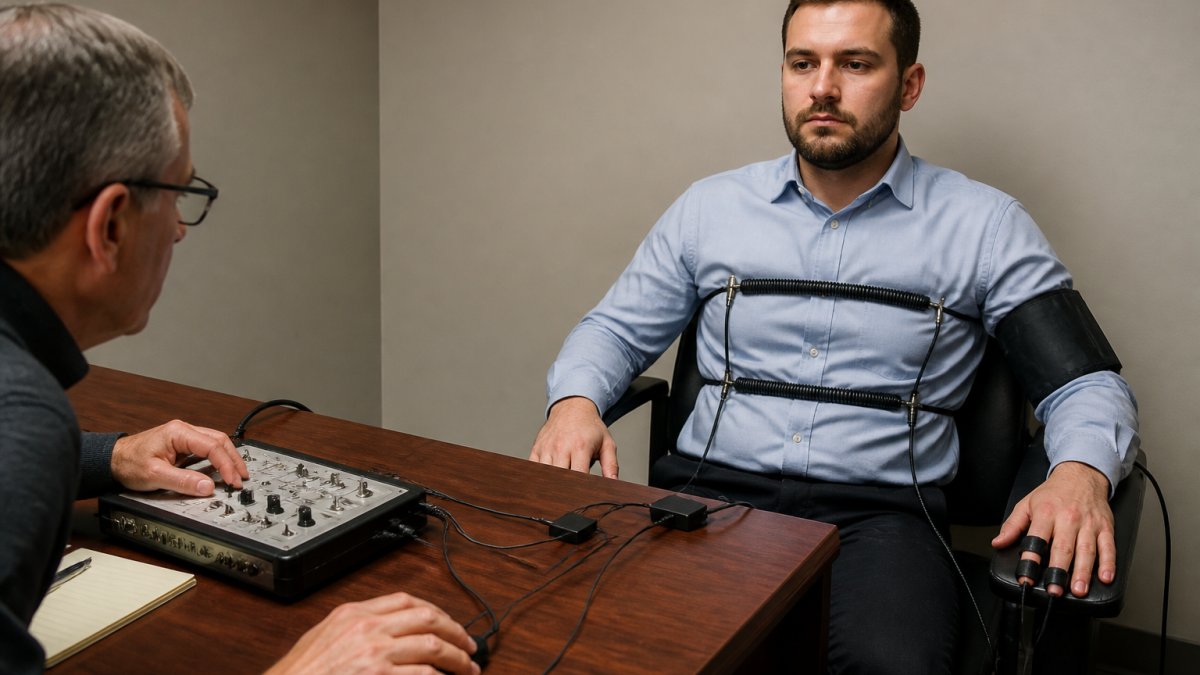
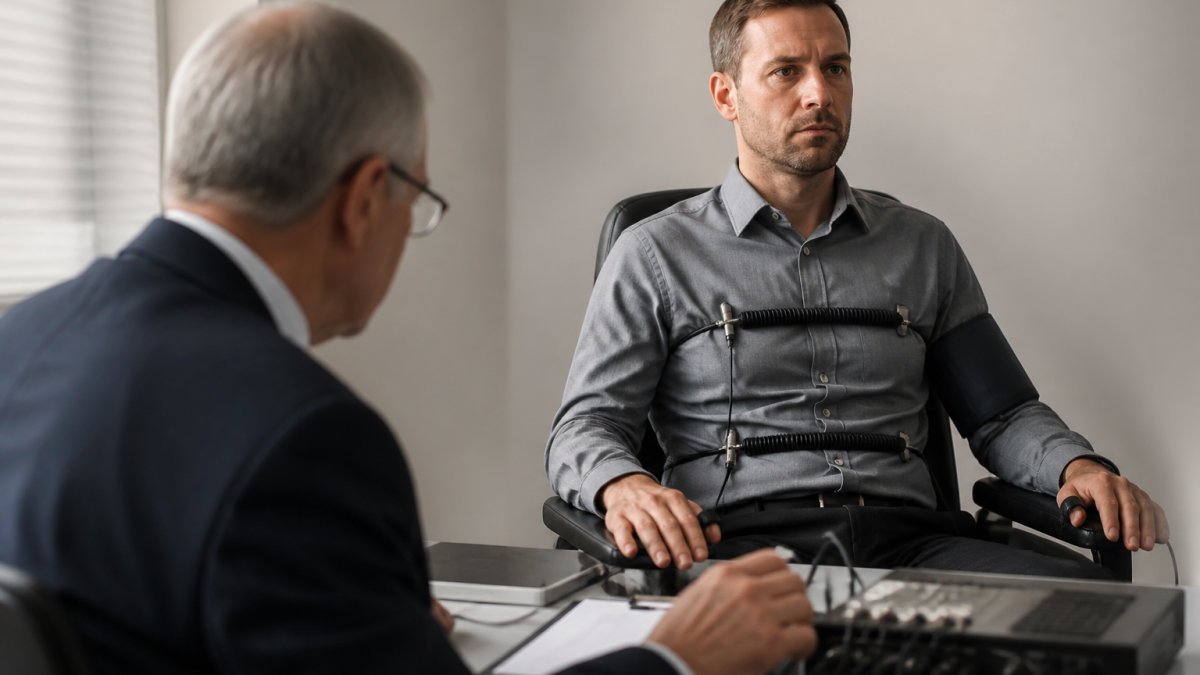
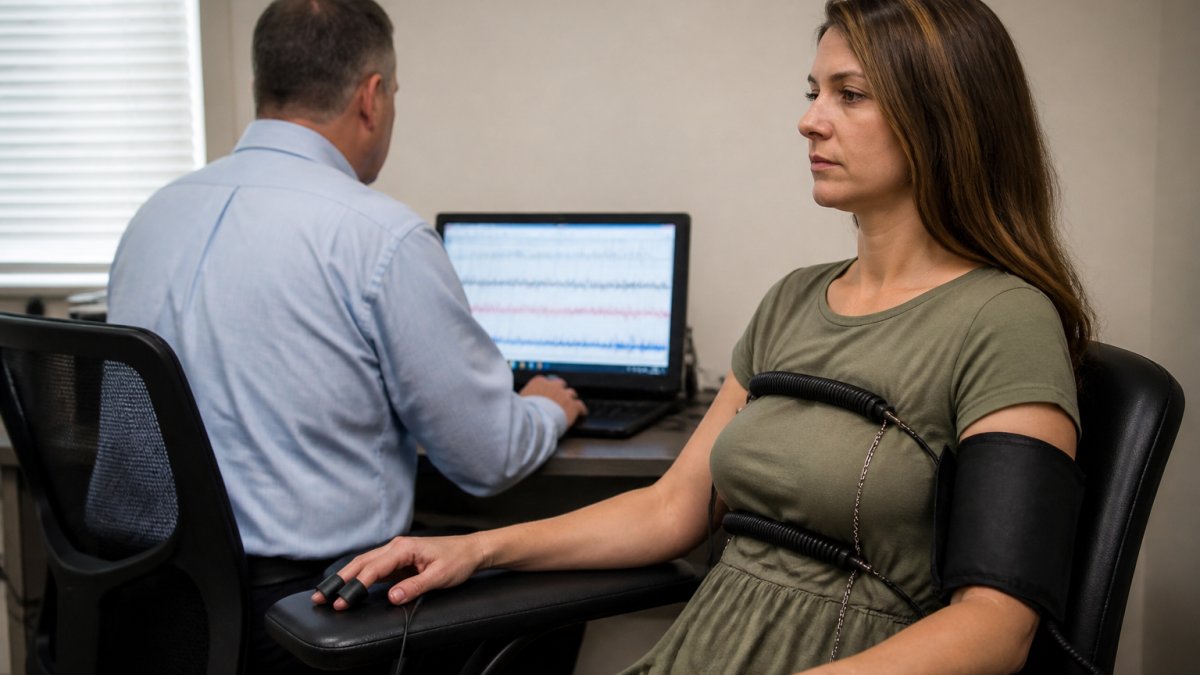
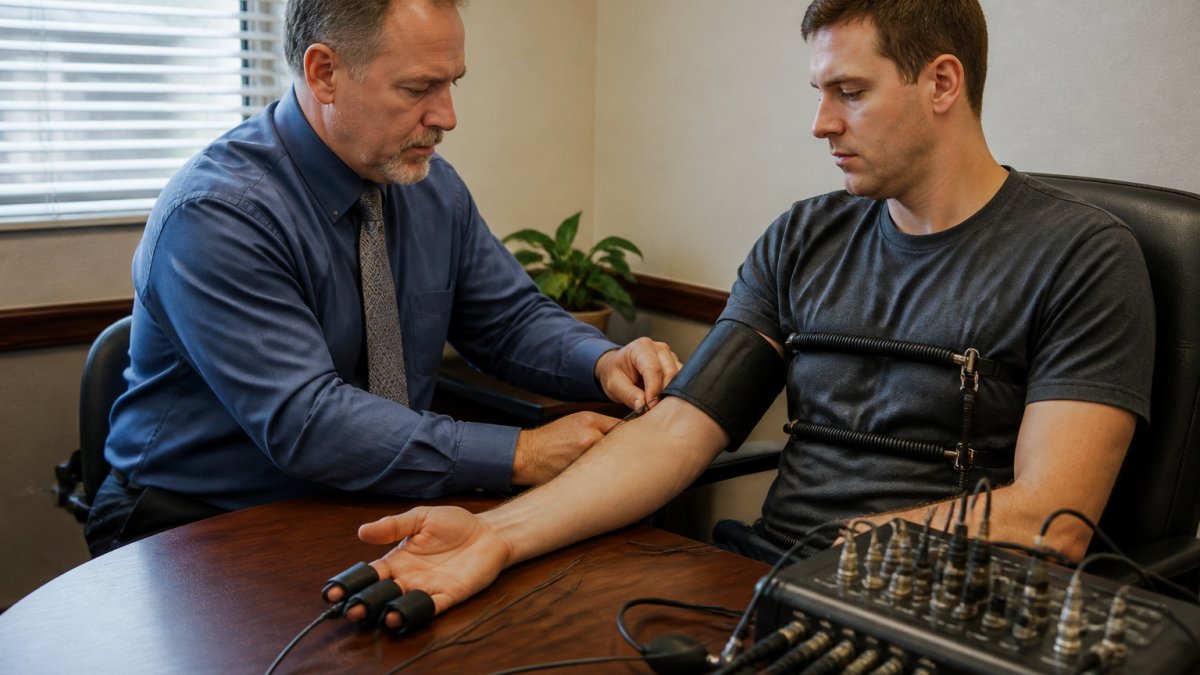
The polygraph records activity controlled by the autonomic nervous system, the part of the body that responds to stress without conscious direction. Examiners monitor several channels at once:
- Heart rate and blood pressure, tracked through a blood pressure cuff
- Respiration, measured by pneumatic tubes across the chest and abdomen
- Skin conductance, recorded through fingertip electrodes that detect sweat gland activity
A spike in these channels during a relevant question suggests the question triggered emotional load. It does not identify why.
Can a Polygraph Prove Infidelity? The Difference Between Detection and Proof
No. A polygraph cannot prove infidelity, and any examiner who promises otherwise is overselling.
That is a meaningful distinction in practice. Detection means the instrument flagged a physiological pattern. Proof means the pattern establishes what actually happened.
The strongest use of an infidelity polygraph is narrowing a question: did this person have physical contact with someone outside the relationship during a defined window?
Accuracy Rates and What the Research Shows
Ask five people how accurate a polygraph is and you will get five numbers, often with equal confidence. That spread is not because one side is lying. It is because the figures measure different things. Understanding which question each number answers is the only way to read an accuracy claim honestly.
Where the Numbers Come From
Three broad sources produce polygraph accuracy figures, and they rarely agree:
- Laboratory studies. Researchers recruit volunteers, assign some to lie and some to tell the truth about a mock scenario, then score the charts. Because the ground truth is known, these studies can calculate error rates precisely. They also tend to use motivated but low-stakes subjects, which may not mirror a real relationship confrontation.
- Field studies. These examine real cases, often criminal, where a confession or other evidence later confirmed what happened. Accuracy looks higher here, but the sample is skewed: cases that get confirmed are not a random draw from all examinations.
- Practitioner and association figures. Professional bodies publish aggregate accuracy ranges based on member-reported outcomes. These are useful for context but are not independent audits.
A common pattern across the literature is that accuracy estimates cluster in the high-80s to mid-90s percent range for well-conducted examinations, with wide confidence intervals. Treat any single figure, high or low, as a range midpoint, not a fixed property of the instrument.
Why Study Design and Test Type Change the Answer
Two examinations can both be called 'polygraph tests' and still produce different accuracy profiles:
- Question technique matters. Comparison-question formats, which contrast relevant questions against broader control questions, behave differently from concealed-information formats that ask about details only a guilty person would recognize. The second type is powerful when the examiner knows a detail the subject does not, and useless when they do not.
- Single-issue versus multi-issue. An infidelity examination usually targets one narrow allegation. Narrow scope tends to improve decision clarity because the relevant questions are specific and the comparison questions can be tuned to the subject.
- Scoring method matters. Some examiners rely on global visual judgment of the chart; others use numerical scoring with defined cutoffs. Numerical scoring is more reproducible, which is why professional standards favor it.
What 'Accuracy' Does Not Tell You
An accuracy rate describes how often a test correctly classifies people across a sample. It does not tell you the probability that a specific result on a specific day is correct.
This is why two examiners can look at the same case and reach different conclusions without either being incompetent. Judgment sits inside the process, and honest examiners say so.
Polygraph False Positive and False Negative Results
A polygraph false positive occurs when a truthful person produces a deceptive result. A false negative occurs when a deceptive person passes. Both happen, and both have real consequences in relationship testing.
False positives are the bigger risk in infidelity cases. An innocent partner who is anxious, sleep-deprived, or blindsided by the accusation can register strong responses to relevant questions. Anxiety looks a lot like deception on a chart.
What Causes Inconclusive Results
An inconclusive result means the data did not support a clear classification either way. Common causes include:
- Medication that dampens autonomic response
- Insufficient sleep or acute illness on test day
- Questions that were poorly worded or too broad
Inconclusive is not a soft "guilty." It means the examination failed to produce usable data. The right response is usually a re-test under better conditions, not a verdict.
Infidelity Polygraph Questions: How Examiners Prepare and Ask Them
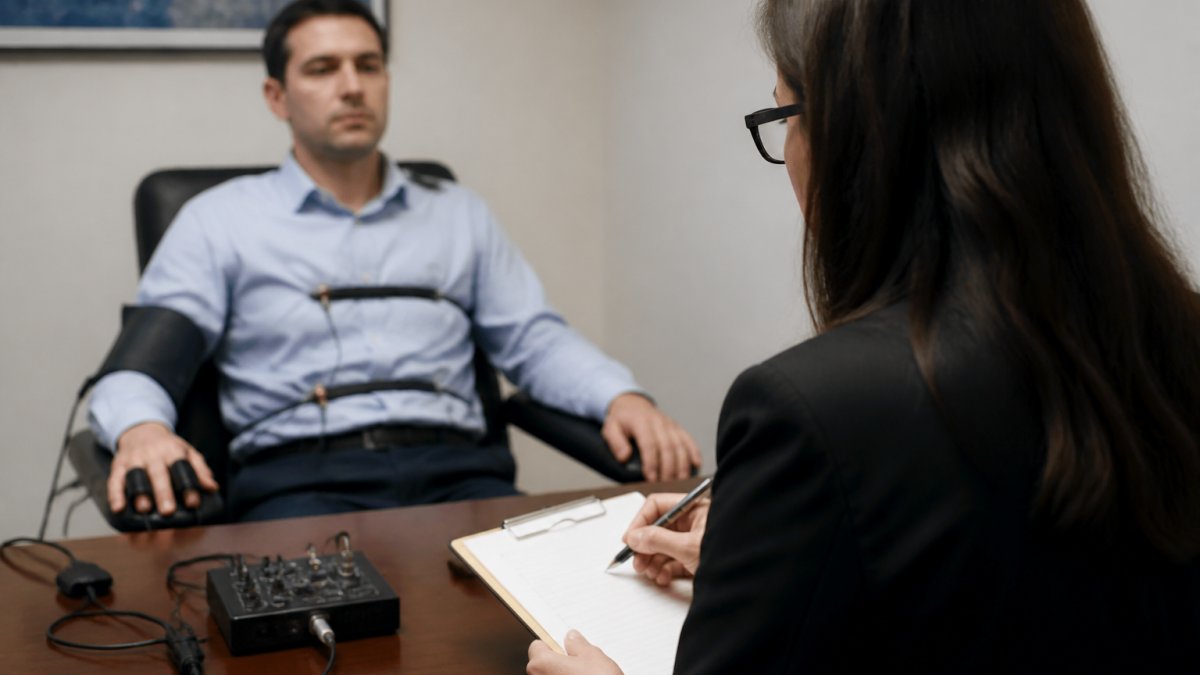
Infidelity polygraph questions are built during a pre-test interview, not improvised during the examination. The examiner and the person being tested agree on the exact wording of every question before any sensor goes on.
A single-issue examination, the standard format for infidelity testing, focuses on one specific allegation. A typical question set includes:
- Relevant questions, such as "Did you have physical contact with [name] on [date]?"
- Comparison questions, which are broad and designed to establish a baseline response
- Neutral questions, used to confirm the recording is reading normally
Question preparation is where most weak examinations fail. Vague or compound questions produce muddy charts. The examiner's job is to make each question answerable with a simple yes or no.
How Long Does a Polygraph Test Take?
A polygraph examination typically takes one to three hours from arrival to completion, though the actual recording phase is usually much shorter. Most of that time goes to the pre-test interview, sensor setup, and a post-test review of the findings.
The recording itself often runs under an hour. If a test wraps in fifteen minutes, be skeptical; a rushed examination usually means the pre-test work was skipped.
Countermeasures, Manipulation, and Test Limitations
People try to beat polygraphs, and the honest answer is that some attempts work better than examiners like to admit. But 'beating' a polygraph is not a single trick. It is a set of techniques aimed at one of two goals: suppress the response to relevant questions, or inflate the response to comparison questions so the contrast disappears.
Common Countermeasures and How They Are Detected
- Controlled breathing. Slowing or speeding respiration can flatten or spike the breathing channel. Examiners watch for breathing that does not match the question pacing, and modern scoring weighs respiration patterns against the other channels.
- Physical pain applied discreetly. Biting the tongue, pressing a thumbnail into a finger, or tensing a muscle during comparison questions is a classic attempt to create a false baseline. Examiners look for movement artifacts, sudden muscle channel changes, and responses that appear at the wrong moment in the question sequence.
- Mental countermeasures. Counting backward, reciting a memorized passage, or visualizing a calming scene can blunt emotional response. These are harder to spot on the chart and are a known limitation of the method.
Detection is not guaranteed. A skilled examiner using a validated protocol and multiple channels has a better chance of flagging manipulation than an examiner relying on a single channel, but no protocol catches every attempt.
How Manipulation Feeds Into Errors and Inconclusive Results
Countermeasures do not usually produce a clean 'pass.' More often they produce noise:
- A subject who successfully blunts relevant responses may still fail comparison questions, producing a deceptive call that is wrong.
- A subject who inflates comparison responses may push the chart into inconclusive territory, which is not a win for either side.
- A subject who overdoes a physical countermeasure may create artifacts that force the examiner to void the examination.
This is why inconclusive results are common in cases where manipulation is suspected. The chart did not support a classification, and the correct response is a re-test under controlled conditions, not a verdict either way.
The Limits No Technique Can Fix
Countermeasures get the attention, but the deeper limitations are structural:
- A polygraph cannot read intent. It records arousal, and arousal has many sources.
- It cannot detect an emotional affair that involved no physical contact, because there is no specific act to ask about.
- It cannot tell you whether a partner is lying about something unrelated to the questions asked.
Legal Status, Admissibility, and Privacy in Infidelity Testing
Polygraph results are generally not admissible as evidence in most court proceedings, and their legal status varies by jurisdiction.
Privacy matters just as much. A reputable provider keeps findings confidential, shares results only with the person who commissioned the test, and never pressures a subject into testing.
If a legal matter is involved, such as a custody dispute, an examiner with court-qualified testimony experience can document findings properly. The American Polygraph Association standards set the professional benchmark examiners should follow, and the Federal Trade Commission guidance on truth-in-advertising is worth reading before trusting anyone who guarantees a specific result.
Infidelity testing works best when it is handled by examiners who are honest about what the instrument can and cannot do.
Frequently Asked Questions
How accurate are polygraph tests for detecting infidelity?
Polygraph accuracy depends on the examiner, the question set, and the conditions of the test. The American Polygraph Association cites decision accuracy figures in the range of 80 to 90 percent when exams follow proper protocol, but those numbers come from controlled studies, not every real-world case. An infidelity polygraph can show whether a person had a significant physiological response to relevant questions, but it cannot confirm what specific act occurred or when. Treat the result as one piece of information, not a verdict.
Can an innocent person fail an infidelity polygraph?
Yes. A false positive happens when a truthful person shows physiological arousal that the examiner interprets as deception. Anxiety, fear of being disbelieved, certain medications, sleep deprivation, and even a strong emotional reaction to the accusation can all trigger reactions that look deceptive on the chart. This is why a qualified examiner conducts a thorough pre-test interview and why a single inconclusive or deceptive result should never be treated as absolute proof of cheating.
Can someone who cheated pass a polygraph test?
It is possible. A false negative occurs when a deceptive person shows no significant physiological response to relevant questions. Skilled manipulators, people who have rehearsed countermeasures, and individuals who genuinely believe their own version of events can sometimes produce a passing result. No polygraph is 100 percent accurate, which is why examiners look at the full picture, including behavior during the pre-test interview and consistency across multiple question sets.
How are questions chosen for an infidelity polygraph?
The examiner builds the question set during a pre-test interview with both parties agreeing on what specific issue is being tested. Questions are typically narrow and single-issue, such as whether the person had physical contact with a named individual during a specific time frame. Relevant questions are mixed with comparison questions that are designed to be emotionally neutral but slightly provocative. The goal is to create a baseline so the examiner can compare reactions across question types.
How long does an infidelity polygraph test take?
Most single-issue infidelity polygraph exams take between 90 minutes and three hours from start to finish. That includes the pre-test interview, sensor setup, the examination itself, and a post-test discussion of the findings. The actual recording phase usually lasts 20 to 45 minutes, with the rest of the time spent preparing questions and ensuring the client is physically comfortable. Complex cases involving multiple issues can run longer.
Should couples rely on a polygraph to resolve relationship doubts?
A polygraph can provide a starting point for a difficult conversation, but it is not a substitute for relationship counseling or honest communication. Many couples use a polygraph as part of a full disclosure process during reconciliation, often alongside therapy. If the underlying issue is broken trust rather than a specific unanswered question, a test result alone will not repair it. Consider what you will do with the answer before you book the exam.